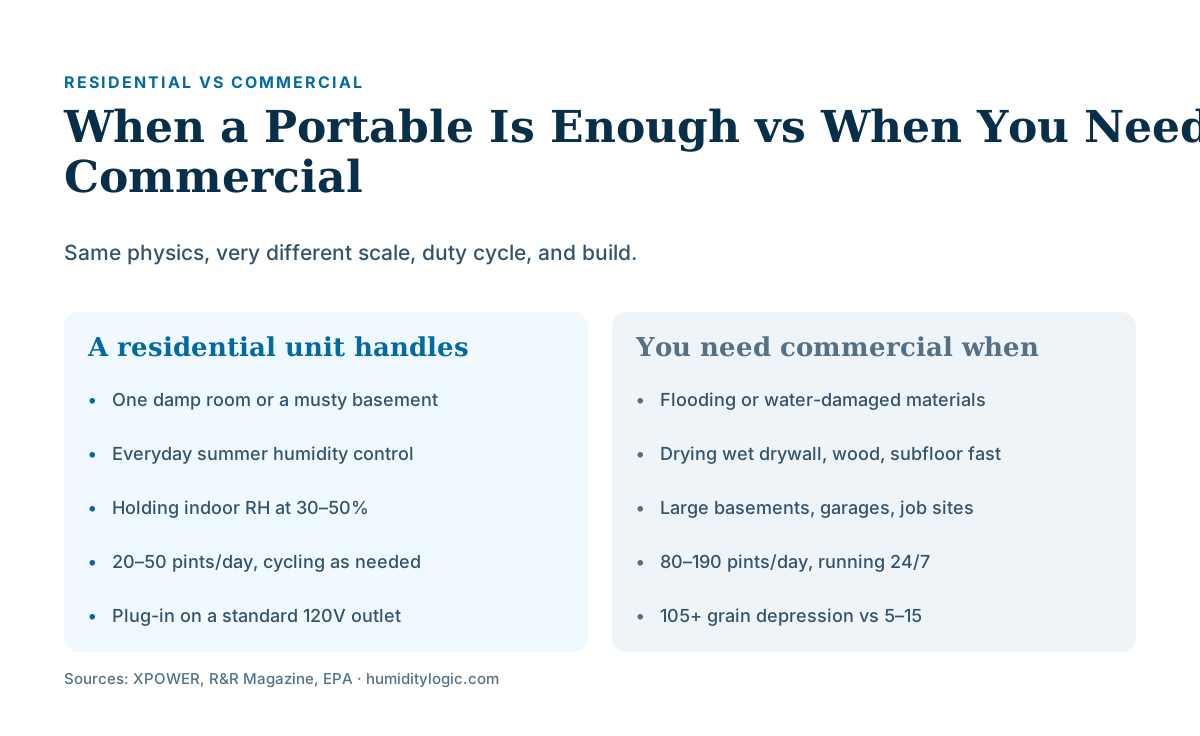
A commercial dehumidifier is a heavy-duty unit that removes 80–190 pints of water per day, runs 24/7 on a steel chassis, and drains through a built-in pump instead of a bucket. It exists to dry out saturated building materials after floods and leaks, so most homeowners only need one temporarily — everyday humidity is a job for a 20–50 pint residential unit.
What is a commercial dehumidifier?
A commercial dehumidifier is a high-capacity, industrial-grade unit built to pull large volumes of moisture out of the air continuously, typically for water-damage restoration, construction drying, and large or demanding spaces rather than a single room in a house.
It works on the same principle as the portable in your basement: a fan draws humid air across cold coils, water condenses out, and the drier air passes back into the room. The difference is everything around that core process. Commercial machines — often called restoration or “LGR” dehumidifiers — use commercial-grade compressors, heavy-gauge steel or rotomolded housings, and drainage designed to run unattended for days. Where a home appliance is engineered for comfort, a commercial unit is engineered to shift as much water as fast as possible and survive being hauled between job sites.
There are two broad families. Portable refrigerant units (including LGR models) look like a rugged version of a home dehumidifier and run on standard 115V power — the XPOWER XD-85L2, for example, is rated at 85 pints per day and weighs about 70 pounds. Large fixed desiccant systems are a different animal: they can move 1,500 to over 10,000 cubic feet of air per minute, weigh from 500 pounds to several tons, and often require 208- or 480-volt three-phase power. A homeowner will only ever encounter the portable kind.
How is a commercial dehumidifier different from a residential one?
Beyond raw capacity, commercial dehumidifiers differ in four ways that matter: how hard they can run, how aggressively they dry the air, how they get rid of the water, and how they are built. Each gap reflects that they are tools for drying structures, not conditioning living space.
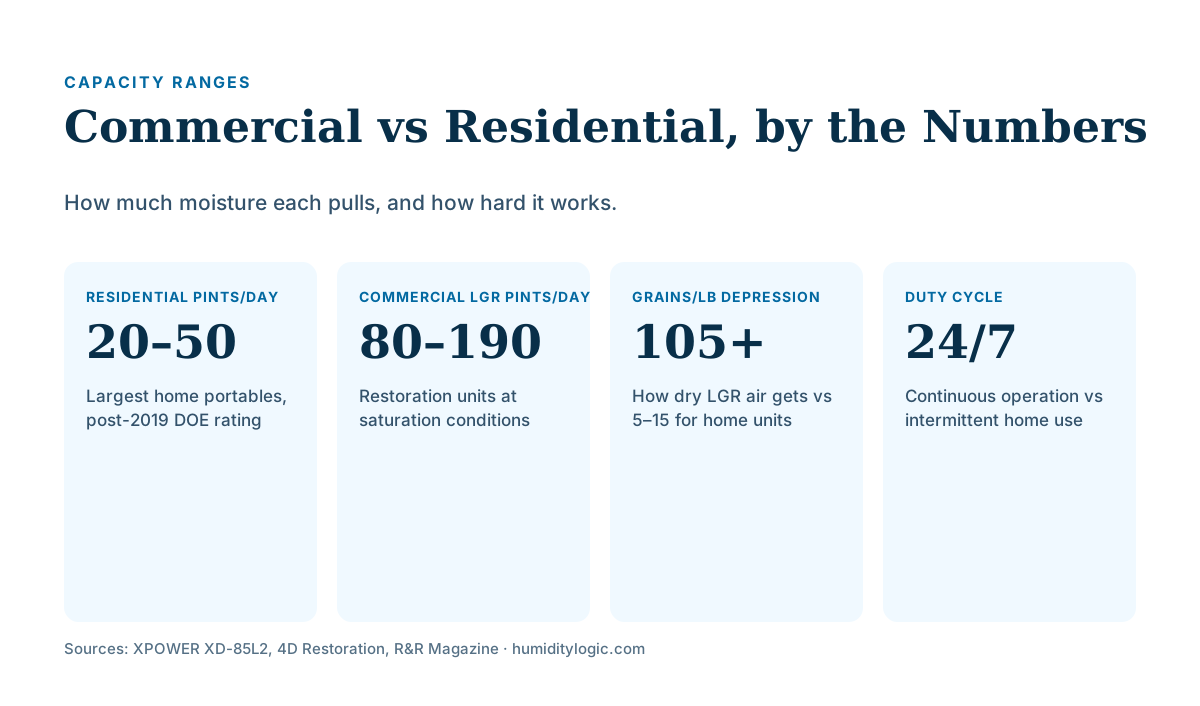
Capacity. The largest home portables rate about 50 pints per day under the current post-2019 DOE test. Portable commercial LGR units rate roughly 80–190 pints per day at saturation, and large industrial systems go higher still. Note the ratings aren’t measured the same way — home units are tested at a realistic 65°F, while commercial units usually quote AHAM (80°F, 60% RH) and saturation (90°F, 90% RH) numbers, so the labeled gap slightly overstates the real-world one. It is still large.
Duty cycle. A residential dehumidifier cycles on and off to hold a comfort setpoint. A commercial unit is designed to run continuously, 24 hours a day for days on end, without overheating or wearing out — the whole point during a dry-down is to never stop until the materials are dry.
Drying power. This is the underappreciated difference. Restoration LGR units use a two-stage cooling process that lets them keep pulling water out of already-dry air, dropping its moisture content by 105+ grains per pound versus 5–15 grains for a consumer unit. That steep gradient is what forces trapped water out of drywall, studs, and subfloor — capacity alone doesn’t do it.
Build and drainage. Commercial units use steel frames, commercial compressors, and a built-in condensate pump that pushes water through a long hose (40 feet on the XPOWER) straight to a drain, so there is no bucket to empty. Home units mostly rely on a tank you empty by hand or a gravity hose that needs a drain below the unit. Commercial machines are also stackable and built to be dragged around, and many rate down to about 33°F — colder than a typical home unit before the coils frost. For a full breakdown of how the refrigerant cycle works, see how a dehumidifier works.
When does a homeowner actually need a commercial dehumidifier?
You need a commercial dehumidifier when you have to dry out saturated building materials fast — after a flood, burst pipe, sewer backup, or major leak — or when the space is simply too big or too wet for a portable to keep up. For ongoing everyday humidity, you don’t.
The clearest trigger is water damage. If a pipe bursts or a basement floods, wet drywall, framing, insulation, and subfloor hold enormous amounts of water, and every hour they stay wet raises the odds of warping and mold. The EPA’s guidance is that mold takes hold within 24–48 hours of materials getting wet, so restoration crews use LGR units to cut drying time from weeks to days. This is almost always a temporary rental — you run the equipment through the dry-down and return it.
The second trigger is scale. A few situations genuinely outrun a residential unit:
- Very large or very wet basements and garages — a big below-grade space that stays above 60% RH despite a home dehumidifier running flat out.
- New construction and remodels — drying fresh concrete, plaster, or a slab before flooring goes down.
- Job sites and outbuildings — a workshop, barn, or unconditioned warehouse space where you need to hit a moisture target on a schedule.
For a chronically damp — but not flooded — basement, you almost never need commercial gear. Start with our basement dehumidifier guide, and if the moisture is house-wide rather than confined to one level, a ducted whole-house dehumidifier is the better long-term fix than an industrial portable running in a corner. And if you’re chasing mold, remember the moisture is the root cause: read using a dehumidifier for mold before assuming bigger equipment is the answer.
A safety note on that mold: the EPA advises that you can clean a moldy area yourself only if it is under about 10 square feet (roughly a 3-by-3-foot patch). Anything larger, or any contamination following major water damage or sewage, should go to a professional — and renting a big dehumidifier does not change that rule.
What size commercial dehumidifier do you need?
For most homeowner situations that call for a commercial unit, an 80–130 pint-per-day portable LGR is the right size; jump higher only for whole-basement floods or spaces well over 2,500 square feet. Sizing is driven by how wet the space is, not just its floor area.
Restoration sizing is more aggressive than the comfort-oriented AHAM chart used for home units, because the goal is speed, not maintenance. As a rough guide, a single 80–125 pint LGR handles small-to-medium jobs up to around 2,500 square feet, while larger floods or open industrial spaces need 150+ pint units — often several running together with air movers to keep air circulating over wet surfaces. The moisture load matters more than the square footage: a 1,000-square-foot basement with two inches of standing water needs far more capacity than a 2,000-square-foot area that is merely damp.
For an everyday (non-emergency) purchase, don’t oversize into commercial territory by reflex. Run your room’s size, climate, and dampness through our dehumidifier sizing calculator, and read what size dehumidifier do I need for the full method — including how to translate old-standard pint ratings, which is exactly the trap that makes commercial numbers look bigger than they are.
Commercial dehumidifier vs desiccant: which for cold or dry conditions?
Choose a portable commercial LGR (refrigerant) unit for typical restoration and warm, humid conditions; choose a desiccant unit for sustained cold or very low humidity, where cold coils lose their grip. Refrigerant machines depend on condensation, so they weaken as air gets cold and dry.
Most portable commercial units are LGR refrigerant models, and they cover the vast majority of homeowner scenarios, working down to about 33°F. But in a sub-freezing garage, an unheated winter job site, or an industrial process that needs very dry air, a desiccant dehumidifier — which adsorbs moisture onto a silica-gel or lithium-chloride rotor rather than condensing it — keeps working where a compressor unit would frost over and stall. That is why large fixed industrial systems are usually desiccant. Our compressor vs desiccant comparison breaks down exactly where each type wins.
The bottom line for a homeowner: commercial dehumidifiers are drying tools, not comfort appliances. Rent one when you’re recovering from water damage or drying a big wet space, size it to the moisture load, and return to a properly sized residential or whole-house unit for the everyday job of holding your home at a healthy 30–50% relative humidity.
Frequently asked questions
What is the difference between a commercial and residential dehumidifier?
A commercial dehumidifier removes far more moisture (roughly 80–190 pints a day versus 20–50 for a home unit), is built for continuous 24/7 operation, uses a steel frame and a built-in condensate pump instead of a bucket, and pulls air much drier. Residential units are sized for everyday home comfort, not for drying out soaked building materials.
Do I need a commercial dehumidifier for my basement?
Usually no. A standard residential or whole-house dehumidifier handles a musty basement fine. You only need commercial-grade equipment when the basement has flooded or the concrete and framing are actively saturated and you need to force moisture out fast, which is typically a temporary rental for the drying period.
What is an LGR dehumidifier?
LGR stands for Low-Grain Refrigerant. These commercial units run intake air through a two-stage cooling process so the air is pre-chilled before it hits the main coil, letting them squeeze water out of very dry air. That is why LGR machines can drop the moisture content by 105+ grains per pound, versus 5–15 for a consumer unit.
Can I rent a commercial dehumidifier?
Yes. Commercial LGR dehumidifiers are widely available to rent by the day or week from tool-rental and restoration-supply outlets, which is the sensible route for a one-time event like a burst pipe or basement flood. Buying only makes sense if you dry spaces professionally or repeatedly.
Will a commercial dehumidifier work in a cold space?
Most portable commercial units are refrigerant-based and keep working down to about 33°F, lower than a typical home unit, because the LGR design resists coil frost. For sustained sub-freezing or very dry industrial conditions, a desiccant dehumidifier is the right tool since it does not rely on cold coils at all.
Sources & references
Every figure on this page is checked against these published sources. Last reviewed July 21, 2026.