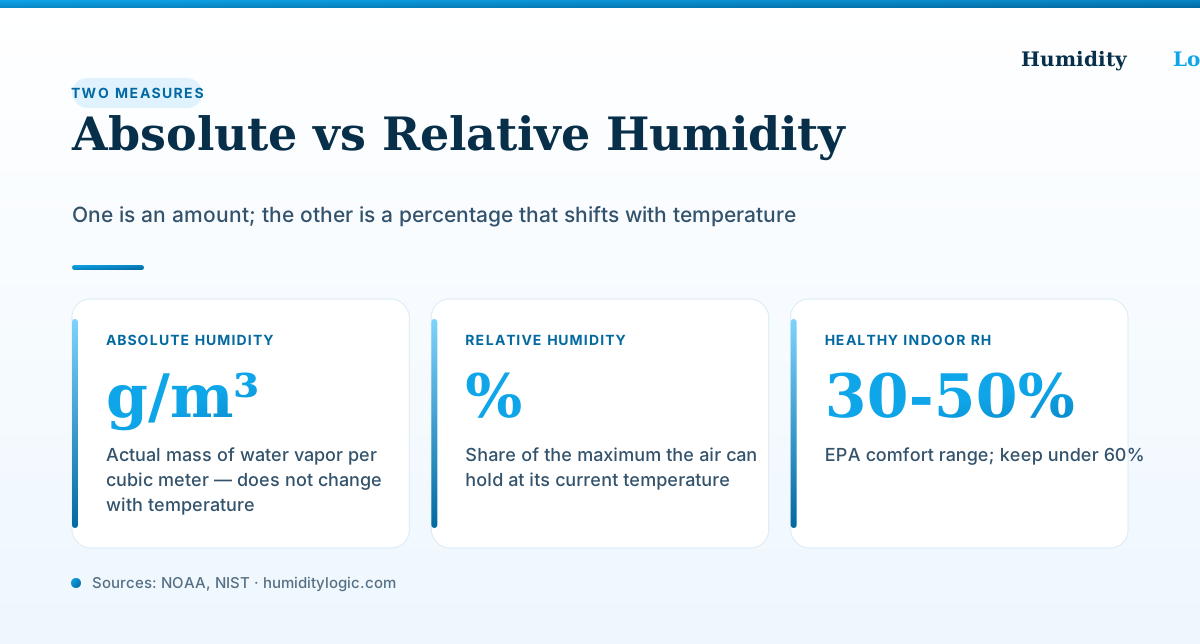
Absolute humidity and relative humidity both describe moisture in the air, but they answer different questions. Absolute humidity is the actual mass of water vapor in a given volume of air, measured in grams per cubic meter (g/m³) — a fixed amount that only changes when moisture is added or removed. Relative humidity is that same moisture written as a percentage of the maximum the air could hold at its current temperature. The critical difference: warm the air and its relative humidity falls even though the absolute humidity has not budged, because warmer air can hold far more water vapor.
What is absolute humidity?
Absolute humidity is the actual amount of water vapor in the air, regardless of temperature. The National Weather Service defines it as “grams of water vapor per cubic meter volume of air” — a direct count of moisture, expressed as a mass packed into a fixed space. The higher the water vapor content, the greater the absolute humidity.
To put the scale in perspective, air can hold only so much vapor before it saturates, and that limit rises fast with heat: around 9 g/m³ at 50°F, roughly 17 g/m³ at 68°F, and about 30 g/m³ at 86°F. Real indoor air usually sits well below its ceiling — a comfortable room might carry 8 to 12 g/m³ — but the ceiling itself is what makes the same moisture feel dry on a hot day and clammy on a cool one.
What makes this measure useful is what it ignores: temperature. If you seal a room’s air and do nothing but heat or cool it, the absolute humidity stays the same, because you have neither added nor removed a single molecule of water vapor. That stability is exactly why meteorologists and engineers reach for it when they need to know how much moisture is genuinely present. For a broader tour of how moisture is described, see our overview of what humidity is and its full definition.
What is relative humidity?
Relative humidity is the amount of water vapor in the air compared with the maximum the air could hold at its current temperature, written as a percentage. NOAA describes it as water vapor “compared to the maximum amount of water vapor that can exist in the air at its current temperature.”
The word “relative” is doing real work. A reading of 50% does not tell you a fixed quantity of water — it tells you the air is halfway to its ceiling for whatever temperature it happens to be. That ceiling is not fixed: it climbs steeply as air warms. So relative humidity blends two facts into one number — how much moisture is present and how much the air could theoretically hold — which is why it is the number your home hygrometer reports and the one covered in depth in our guide to relative humidity. When RH reaches 100%, the air is saturated and moisture begins condensing out as dew or fog.
Why does relative humidity change with temperature when absolute humidity doesn’t?
Because relative humidity is a ratio, and only its denominator moves. The moisture in the air is the numerator; the air’s capacity to hold moisture is the denominator, and that capacity rises sharply as temperature climbs. Add heat and the denominator grows while the numerator sits still, so the percentage drops.
The National Weather Service puts the rule plainly: “With the same amount of absolute/specific humidity, air will have a HIGHER relative humidity if the air is cooler, and a LOWER relative humidity if the air is warmer.” This is why RH is typically highest in the early morning, when the air is coolest, and lowest in the afternoon, when it has warmed — even though the actual water content barely moves across the day. It is also why homes feel parched in winter: heating indoor air expands its capacity, pushing the RH down without removing any moisture. Absolute humidity, counting only the vapor itself, never enters into any of this.
How do absolute and relative humidity differ in a worked example?
Take one parcel of air holding a fixed 15 grams of water vapor per cubic meter and change nothing but its temperature. The absolute humidity stays 15 g/m³ the entire time — only the relative humidity moves:
- At 86°F, air can hold roughly 30 g/m³ before saturating. Our 15 g/m³ fills about half of that, so the relative humidity is about 50%.
- Cool that same air to 68°F, where capacity drops to about 17 g/m³. The unchanged 15 g/m³ now fills most of the available room, and the relative humidity climbs to roughly 87%.
- Cool it a little further, to about 63°F, and 15 g/m³ is all the air can hold. It is now saturated: relative humidity hits 100%, and that temperature is the parcel’s dew point.
Nothing was added or removed — the absolute humidity held steady at 15 g/m³ throughout — yet the relative humidity swung from 50% to 100%. You can run this kind of temperature-and-moisture math for any starting point with our dew point calculator, which finds the exact temperature where a given amount of moisture reaches saturation.
What about specific humidity?
Specific humidity is a close cousin of absolute humidity that measures moisture against the weight of the air rather than its volume. The National Weather Service defines it as “grams of water vapor per kilogram of air” — the mass of water vapor carried in a unit mass of air.
The distinction matters to meteorologists because a volume of air expands and contracts as it rises, warms, and cools, which nudges the absolute humidity value even when no moisture is gained or lost. Specific humidity sidesteps that problem: since it is tied to mass, it stays constant as a parcel of air balloons or shrinks. For everyday household purposes the two are effectively interchangeable — both answer “how much water vapor is actually here?” rather than “what percent of capacity is filled?”
Which humidity measure matters most for your home?
For managing your home, relative humidity is the number to watch — but understanding absolute humidity explains why RH behaves the way it does. Your hygrometer reports RH, and the EPA recommends keeping indoor relative humidity “below 60 percent – ideally between 30 percent and 50 percent.” That band keeps most people comfortable while holding down mold and dust mites, which climb sharply once RH passes 60%.
Absolute humidity is what actually drives comfort and condensation, even though you rarely measure it directly. Air at 80°F and 50% RH holds far more water vapor than air at 30°F and 100% RH, which is why NOAA notes the warm day “would feel much more ‘humid’” despite the lower percentage — its dew point, and therefore its absolute humidity, is higher. Dew point tracks that actual moisture directly, which is why it is the better comfort gauge; our guide to dew point versus humidity unpacks the connection. When you spot the telltale signs of genuinely high humidity — musty smells, condensation on windows, damp walls — it is high absolute moisture you are fighting, and lowering the RH into the 30–50% range is how you win.
The bottom line
Absolute humidity and relative humidity are two lenses on the same moisture. Absolute humidity, in grams per cubic meter, counts the water vapor that is actually there and never changes with temperature. Relative humidity turns that count into a percentage of what the air could hold, so it rises and falls as the air cools and warms even when the moisture stays put. At home, target relative humidity — 30% to 50%, under 60% — but remember that the real moisture load beneath the percentage is what determines how the air feels and where condensation forms.
Frequently asked questions
What is the difference between absolute and relative humidity?
Absolute humidity is the actual mass of water vapor in the air, measured in grams per cubic meter. Relative humidity is that moisture expressed as a percentage of the maximum the air could hold at its current temperature. One is a fixed amount; the other is a ratio that shifts as the air warms or cools.
What are the units of absolute humidity?
Absolute humidity is measured in grams of water vapor per cubic meter of air (g/m³). Relative humidity, by contrast, is a percentage with no physical unit. Specific humidity is a related measure given in grams of water vapor per kilogram of air, which is handy because it does not change as air expands or contracts.
Why does relative humidity change with temperature but absolute humidity does not?
Absolute humidity counts the water vapor actually present, so it only changes if moisture is added or removed. Relative humidity compares that moisture to the air's capacity, and capacity rises steeply with temperature. Warm the same air and its capacity grows, so the unchanged moisture fills a smaller share and the percentage drops.
Which humidity measurement should I use at home?
Use relative humidity indoors. Home hygrometers report it, and the EPA's guidance to stay between 30% and 50% is written in RH. Because a thermostat holds room temperature fairly steady, relative humidity becomes a dependable target for comfort, mold control, and condensation, even though it swings with temperature elsewhere.
Is dew point the same as absolute humidity?
No, but both track the actual moisture present rather than a percentage. Dew point is the temperature at which air becomes saturated, while absolute humidity is the mass of vapor per cubic meter. They move together: a higher dew point means more water vapor and therefore a higher absolute humidity, which is why dew point is a reliable comfort gauge.
Sources & references
Every figure on this page is checked against these published sources. Last reviewed July 28, 2026.