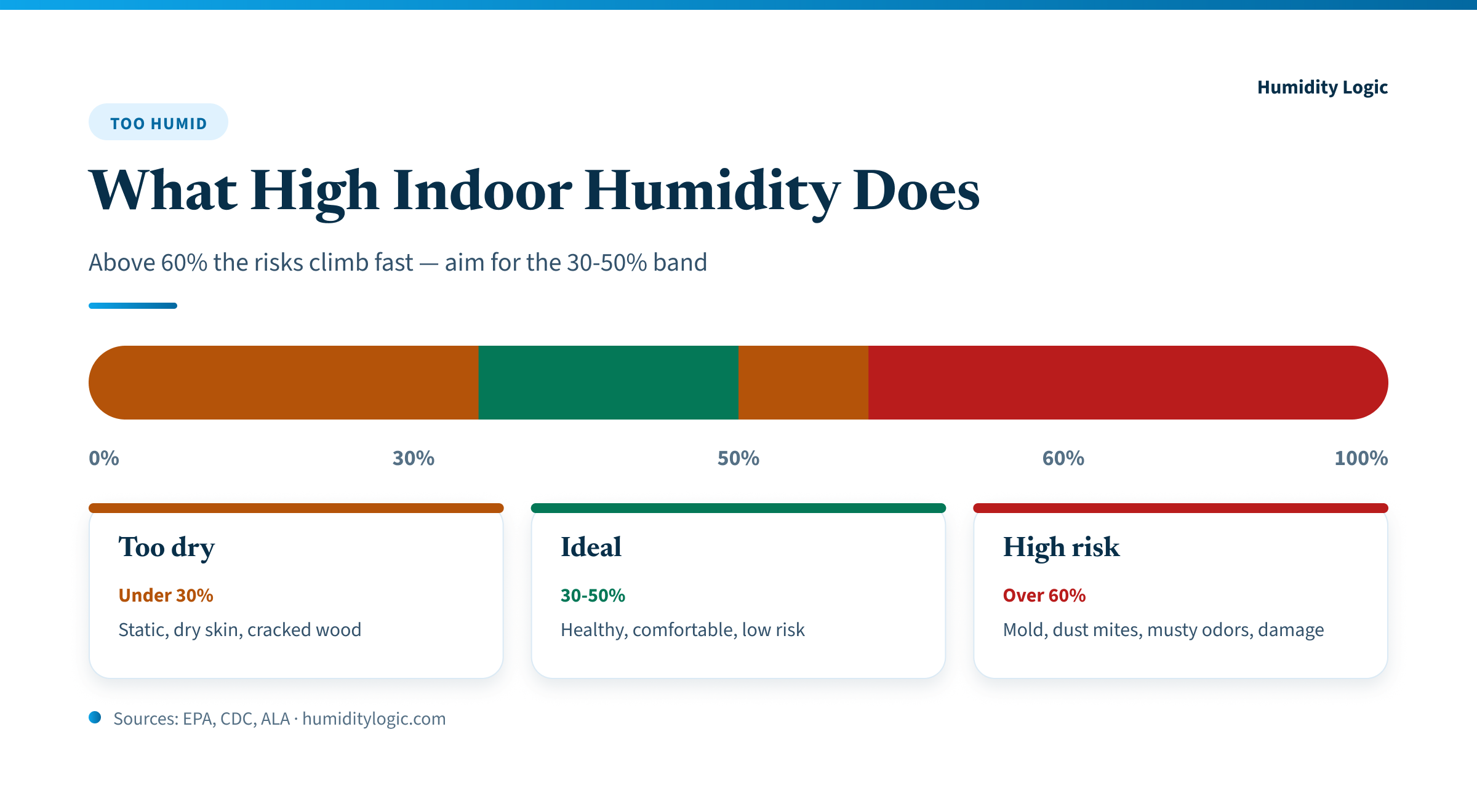
Indoor humidity that stays above 60% RH is where the trouble starts: sustained dampness feeds mold and mildew, lets dust-mite populations multiply, breeds musty odors, condenses on cold windows and walls, and swells wood floors and framing — while making warm rooms feel heavier than they should. The EPA recommends keeping indoor relative humidity below 60% and ideally in the 30-50% band, which is comfortable for people and hostile to nearly all of those problems.
Why Is High Humidity a Problem Indoors?
Because water vapor is the one ingredient every household nuisance needs. Mold spores are always in the air, dust mites live in every mattress, and wood is always ready to absorb moisture — none of it becomes a problem until the air gives it enough water to work with. Below 50% RH those threats stay dormant. Push the air past 60% and hold it there, and each one wakes up at once.
Relative humidity is the right yardstick indoors because home temperatures stay in a narrow band around 68-75°F, so the percentage means roughly the same thing all year. (Outdoors, where temperatures swing 30 degrees in a day, dew point is the better measure — see what is considered high humidity for that distinction.) Inside, the number to remember is 60%: below it, most homes stay healthy; above it, the damage compounds. And the trouble is cumulative, not instant — a brief spike after a hot shower is harmless, but air parked at 65% for weeks is what rots a window frame and blackens a closet corner.
How Does High Humidity Cause Mold and Mildew?
Mold is the headline danger, and it is entirely a moisture story. According to the EPA, mold needs moisture, a food source, and the right temperature to grow — and in a typical home the food (drywall paper, wood, dust, fabric) and temperature are always present. Moisture is the only variable you control, which is why the EPA’s core principle is blunt: “The key to mold control is moisture control.”
Above 60% RH, porous surfaces stay damp enough for spores to germinate, and once a colony takes hold it spreads fast. The EPA also warns that wet or water-damaged materials should be dried within 24 to 48 hours to prevent growth — a window that closes quickly in a humid house where nothing ever fully dries. That is why the worst mold is usually hidden: behind bathroom tile, inside a poorly ventilated closet, under a basement carpet, or in the corner of an exterior wall where warm indoor air meets cool masonry. By the time a stain shows on the surface, the colony has usually been feeding on the damp material behind it for weeks.
Mildew is the early, surface-level stage of the same process — the flat, powdery gray or white film that shows up on bathroom grout and window sills before true mold digs in. It is the visible warning that the air is too wet; our guide to mildew vs. mold covers how to tell them apart and why the fix for both is the same. If mold has already taken hold in a damp basement or bath, a dehumidifier for mold removes the moisture that lets it return.
What Does High Humidity Do to Your Health?
This is where care matters, because damp air does not diagnose anyone — but health authorities are clear that damp, moldy indoor environments are associated with real respiratory effects. The CDC reports that people who spend time in damp, moldy buildings can develop a stuffy nose, sore throat, coughing or wheezing, and burning eyes, and that exposure can worsen existing asthma. People with mold allergies, asthma, or weakened immune systems may react more severely. The CDC’s plain-language advice is to keep indoor humidity as low as you can, no higher than 50%.
The second health pathway is dust mites. These microscopic relatives of spiders live in bedding, upholstery, and carpet, and they absorb moisture straight from the air rather than drinking it. The American Lung Association calls them one of the major indoor asthma triggers and notes that roughly four out of five U.S. homes carry dust-mite allergens in at least one bed. Their populations climb with humidity, which is exactly why the ALA recommends keeping your home below 50% — dry air is the simplest way to keep mite numbers down. None of this is a medical diagnosis; if symptoms persist, that is a conversation for a doctor. But it explains why the healthy-humidity target doubles as an allergy-and-asthma measure.
Can High Humidity Damage Your House?
Yes, and often more expensively than a mold cleanup. The most common structural symptom is condensation: when humid indoor air meets a cold surface — a single-pane window, an uninsulated exterior wall, a cold-water pipe — the water vapor turns to liquid. Left alone, that moisture peels paint, stains drywall, rots window frames, and drips inside wall cavities where you never see it until the damage is done. Our explainer on what condensation is shows exactly when and where it forms.
Wood is the other casualty. Floorboards, doors, trim, and framing all absorb ambient moisture and swell, which is why doors and drawers start sticking in a humid summer and gaps open back up in a dry winter. Sustained high humidity keeps hardwood floors slightly expanded year-round, leading to cupping and permanent warping. Add the musty odor that soaks into closets, basements, and soft furnishings — a smell that is itself a sign of microbial growth — and the case for control is as much about protecting the house as protecting your lungs.
What Is the Ideal Humidity, and How Do You Get There?
Aim for 30-50% RH, and treat 60% as a ceiling you should not sit at. That target comes straight from the EPA and threads the needle: high enough to avoid dry-air problems like static, cracked wood, and irritated sinuses, low enough to shut down mold, mites, and condensation. Our guide to ideal indoor humidity levels covers how the sweet spot shifts slightly by season.
Start by measuring. A basic digital hygrometer costs about $10-15; place one in the room you suspect, away from bathroom and kitchen steam, and read it in the afternoon. A single spike means nothing — readings parked above 60% day after day are the problem. You can check where your target sits for your own home with our humidity comfort checker.
Then match the fix to the source:
- Ventilate moisture at the point it is made. Run bathroom and kitchen exhaust fans during and for 20 minutes after showering or cooking, and vent the clothes dryer outdoors, never into a basement or attic.
- Let air conditioning do double duty. AC removes moisture as it cools, which is why humid-climate homes often hold a comfortable 50% RH through summer without extra equipment.
- Add a dehumidifier where the moisture is chronic. A basement or crawl space that reads high all season needs a unit sized to the space; this is the most reliable fix for below-grade dampness.
- Cut the moisture off at the source. Sealing a crawl space, correcting grading and gutters so rainwater drains away from the foundation, and fixing plumbing leaks stop humidity before it enters.
Our full walkthrough of how to lower humidity in your house ranks every one of these by cost and impact.
The dangers of high humidity — mold, mildew, dust mites, musty odors, condensation, and wood damage — all trace back to the same root cause and the same fix. Keep the air in the 30-50% range, never let it sit above 60%, and nearly every one of those problems loses the moisture it needs to take hold.
Frequently asked questions
What are the main dangers of high humidity in a house?
Sustained indoor humidity above 60% feeds mold and mildew growth, lets dust-mite populations climb, produces musty odors, causes condensation on windows and walls, and swells wood floors, doors, and framing. It also makes rooms feel warmer and clammier than the thermostat reads. The EPA recommends keeping indoor relative humidity below 60%, ideally between 30% and 50%.
At what humidity level does mold start to grow?
Mold risk climbs once indoor relative humidity stays above 60%, because damp air keeps porous surfaces like drywall and wood moist enough to support growth. The EPA's guiding principle is that controlling moisture controls mold, which is why it advises holding indoor RH below 60% and drying any wet materials within 24 to 48 hours.
Can high humidity make you sick?
High humidity itself is not an illness, but the damp conditions and mold it encourages are linked to health effects. The CDC reports that people in damp, moldy buildings can experience stuffy nose, coughing, wheezing, and worsened asthma, and dust mites thriving above 50% RH are a major asthma and allergy trigger. If you have ongoing symptoms, see a medical professional.
What humidity level should I keep my house at?
Aim for 30% to 50% relative humidity, and never let it sit at 60% or higher for long. This is the range the EPA recommends: high enough to avoid dry-air problems like static and cracked wood, low enough to suppress mold, dust mites, and condensation. A $10-15 hygrometer lets you confirm where your rooms actually sit.
How do I lower high humidity in my home?
Match the fix to the source. Run bathroom and kitchen exhaust fans during and after showering or cooking, vent your dryer outdoors, and use air conditioning in summer since it removes moisture as it cools. For a basement or crawl space that reads high all season, a properly sized dehumidifier is the reliable fix. Sealing crawl spaces and correcting outdoor drainage address moisture at the source.
Sources & references
Every figure on this page is checked against these published sources. Last reviewed July 29, 2026.