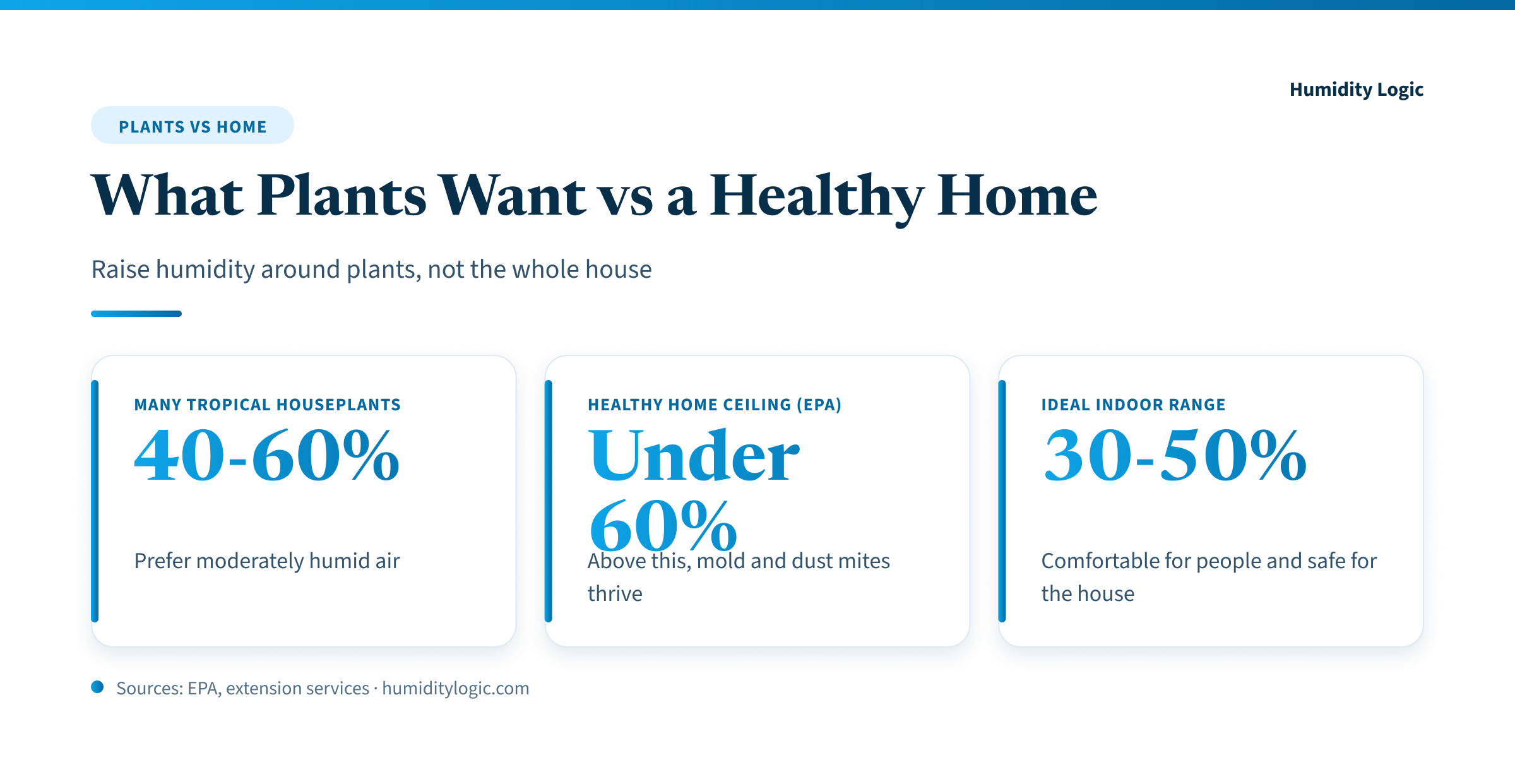
Most common houseplants are happiest at 40-60% relative humidity, and true tropicals like ferns and calatheas prefer 70-80% — but the EPA says a healthy home should stay under 60%, ideally 30-50%. The way to serve both is to raise humidity around your plants, not across the whole house: group plants together, use pebble trays, and run a small humidifier nearby while a hygrometer keeps the room from drifting into mold territory.
What Humidity Do Houseplants Actually Need?
Most houseplants want 40-60% relative humidity, and the tropical species people struggle with want considerably more. According to University of New Hampshire Extension, “most houseplants (excluding cacti, succulents and a few others) prefer a relative humidity range of 40-60%,” while tropical species thrive at 70-80%. That upper band is the origin of nearly every drooping-fern and crispy-leaf-edge complaint: plants native to rainforest understory are being asked to live in a heated winter living room.
Not every plant is demanding. Cacti and succulents evolved in arid places and are perfectly content in ordinary dry indoor air — trying to humidify them can do more harm than good. The practical takeaway is to sort your collection: forgiving plants (pothos, snake plant, ZZ) tolerate normal home humidity, mid-range plants (monstera, philodendron) do better toward 50%, and the divas (calathea, maranta, ferns, orchids) are the only ones that genuinely need a deliberate humidity boost.
You can also let the plants tell you. Crispy brown leaf edges and tips, curling foliage, flower buds that drop before opening, and slowed growth are the classic signs that a tropical is sitting in air that is too dry — most often in winter, when heating systems drive indoor humidity down. Before assuming it is a humidity problem, rule out the common lookalikes: underwatering, salt buildup from tap water, and hot air blowing directly from a nearby vent all produce similar crispy edges. If the room genuinely reads in the 20s or 30s on a hygrometer and the plant is a known moisture-lover, humidity is the likely culprit.
Why Not Just Humidify the Whole House to Plant Levels?
Because a house is not a greenhouse, and the moisture that pleases a fern damages a home. The EPA is explicit: “If possible, keep indoor humidity below 60 percent (ideally between 30 and 50 percent) relative humidity.” Push a whole home toward the 70-80% that tropical plants love and you cross straight into the range where mold colonizes drywall and framing, dust mites multiply, and water condenses on cold windows and exterior walls.
This is the central tension, and it resolves cleanly once you stop thinking in whole-house terms. Your thermostat-mounted or console humidifier moves the entire building’s air; that is the wrong tool for a shelf of calatheas. The goal is a humid microclimate a few feet across — enough for the plants, low enough that the rest of the house stays in the safe 30-50% band. If your home already runs damp, read what counts as high humidity before adding any moisture, and if you are fighting dampness, our guide to why your house is so humid tackles the source.
How Do I Raise Humidity Around Plants Without Wetting the Whole House?
Group the plants, sit them on pebble trays, and add a small humidifier aimed at the cluster — in that order of effort. Each step keeps the moisture local.
Grouping is the free first move. Plants release water vapor through their leaves, so a tight cluster raises the humidity of its own little pocket of air. UNH Extension explains that “water that evaporates from the potting media or transpires from the leaves can increase relative humidity by creating a microclimate,” and notes the effect is strongest with several plants together in a low-airflow spot. Nebraska Extension adds a placement tip: naturally humid rooms like bathrooms and kitchens beat spots near vents, radiators, or drafty doors.
A small humidifier does the heavy lifting for true tropicals. Placed close to the plants and run for a few hours a day, it lifts the local reading without flooding the house — provided you keep an eye on it. That last part matters: check the room with a humidity meter so you can dial it back before the space sits above 60% for hours at a time. You can also sanity-check whether the whole room is drifting out of the comfort zone with our humidity comfort checker.
Two more low-effort options can substitute for a humidifier with fussy plants. A glass enclosure — a terrarium, cloche, or repurposed aquarium — traps transpired moisture and holds a genuinely tropical microclimate; UNH Extension calls these “excellent ways to maintain a high-moisture environment,” with the reminder to crack the lid occasionally so it does not turn into a mold incubator. And simply relocating a moisture-lover to your most humid room, typically a bathroom with a window, often solves the problem for free. Whatever you choose, resist the urge to overwater as a shortcut to humidity: soggy soil leads to root rot, not happier leaves, and the water belongs in the air, not pooled in the pot.
Do Pebble Trays and Misting Really Work?
Pebble trays help a little; misting barely helps at all. A pebble tray — a shallow dish of stones and water with the pot resting on the stones, not in the water — adds evaporation right at the base of the plant. Both UNH and Nebraska Extension describe it as a modest, localized boost that works best under several grouped plants in still air. It is a genuine supplement, but it will not convert a 30% winter room into 50% air on its own.
Misting is the method to skip. University of Maryland Extension says plainly that “it is questionable whether misting plants really increases humidity,” because any rise “only lasts until the water evaporates” — meaning even daily misting does almost nothing for ambient humidity. Nebraska Extension goes further, warning that wet foliage left sitting overnight encourages fungal leaf disease. If you enjoy misting, treat it as a leaf-cleaning ritual, not a humidity strategy.
Why Does Over-Humidifying Invite Mold?
Because mold is a moisture problem first and foremost, and the plant corner is a common hidden source. The EPA’s guiding principle is that controlling moisture controls mold, and it specifically flags condensation on windows, walls, and pipes as the warning sign that a room has too much water in the air. A humidifier running full-time next to a wall, or a dense jungle of plants transpiring into a closed, cool room, can push the local air past 60% for long stretches — exactly the condition mold spores need on drywall, baseboards, and soil surfaces.
Two habits keep it in check. First, ventilate: a little air movement stops humid pockets from stagnating against cold surfaces. Second, measure: a cheap hygrometer near the plants tells you when to ease off. If you already see musty smells, dark spotting, or peeling paint near a plant cluster, treat it as a moisture issue and see our guidance on a dehumidifier for mold. The point of localizing plant humidity is precisely to avoid this outcome elsewhere in the house.
What Humidity Should the Rest of My House Stay At?
Everywhere outside the plant zone, aim for the standard healthy range: 30-50% relative humidity, and never sustained above 60%. That is the band the EPA recommends for keeping mold, dust mites, and condensation at bay, and it is comfortable for people too. Our full breakdown of ideal indoor humidity levels covers how the target shifts by season — lower in freezing winter to keep windows from sweating, up toward 50% in humid summer.
The two goals only seem to conflict. A calathea wanting 70% and a house wanting under 50% coexist fine when the humid air is confined to a tray, a cluster, and a small humidifier’s throw. If a whole-house reading is creeping up because of plants plus everyday cooking and showering, the fix is ventilation or drying, not accepting damp air — our guide to lowering humidity in a house walks through it. Keep the plants happy in their pocket, keep the house in the 30-50% zone, and both come out ahead.
Frequently asked questions
What humidity level do houseplants need?
Most common houseplants prefer 40-60% relative humidity, and true tropicals like calatheas and ferns want 70-80%. Cacti and succulents are the exception and are happy in ordinary dry indoor air. Match the target to the plant rather than humidifying every room to jungle levels.
Can I keep my whole house at the humidity my plants want?
You should not. The EPA advises keeping indoor humidity under 60%, ideally 30-50%, because sustained higher levels feed mold, dust mites, and condensation. Raising a whole home to the 70-80% tropical plants love invites moisture damage. Create humidity around the plants instead of soaking the house.
Does misting houseplants actually raise humidity?
Barely. University of Maryland Extension calls it questionable, noting any rise lasts only until the water evaporates, so even daily misting does little for ambient humidity. Worse, wet leaves overnight encourage fungal leaf disease. Grouping plants, pebble trays, and a small humidifier all work better.
Do pebble trays work for plant humidity?
A little. A tray of pebbles and water under a pot adds some evaporation right around the foliage, and the effect is strongest with several plants grouped in a low-airflow spot. On its own in a dry winter room it will not turn 30% air into 50% air. Treat it as a supplement, not the whole fix.
What is the safest way to give plants more humidity?
Cluster plants together, set them on pebble trays, and run a small room humidifier nearby, then watch a hygrometer so you stop before the room sits above 60%. Keeping the humid zone local to the plants protects the rest of your house from the mold and condensation that whole-home humidifying can cause.
Sources & references
Every figure on this page is checked against these published sources. Last reviewed July 27, 2026.
- US EPA — A Brief Guide to Mold, Moisture and Your Home
- University of New Hampshire Extension — How Can I Increase the Humidity Indoors for My Houseplants?
- University of Maryland Extension — Temperature and Humidity for Indoor Plants
- Nebraska Extension in Lancaster County — Success with Houseplants: Humidity