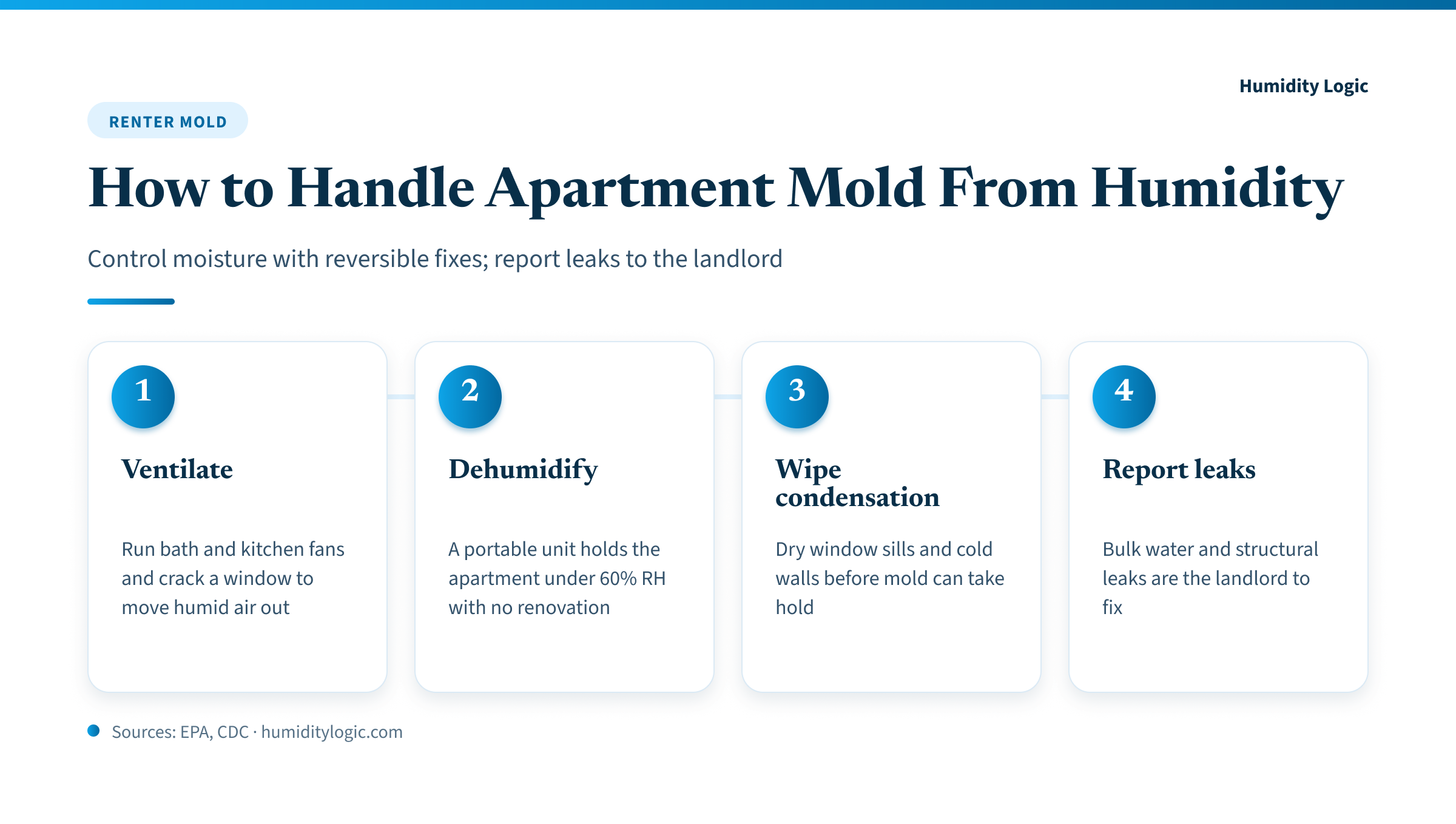
Apartment mold comes from humidity and poor ventilation — damp air from showering, cooking, and drying laundry gets trapped in a tight unit and condenses on cold walls, closets, and windows until mold takes hold. As a renter you control it with ventilation and a portable dehumidifier that holds the air under 60% relative humidity, plus reversible habits like wiping condensation and keeping airflow. When the moisture comes from a leak or bulk water, that is structural — report it to your landlord in writing, because the repair is their job, not yours.
Why Does My Apartment Get Mold?
Mold needs one thing to grow: a damp surface. Everything else — the spores, the warmth, the dust it feeds on — is already present in every apartment. So mold is really a moisture story, and in a rental that moisture usually comes from humid indoor air with nowhere to go.
Everyday living pumps water vapor into the air. A single hot shower can push a small bathroom close to saturation; boiling a pot of pasta, running a humidifier, or air-drying a load of laundry all add liters of water to the room. Apartments trap it because they are often compact, tightly sealed, and short on cross-ventilation. The EPA notes that buildings sealed tight since the 1970s can “lack adequate ventilation,” and “without adequate ventilation, moisture may build up indoors and mold may grow.”
That trapped, humid air then finds the coldest surfaces in the unit and condenses. “When warm, humid air contacts a cold surface, condensation may form,” the EPA explains — and those cold surfaces are exactly where renters find mold: exterior walls behind a dresser, the ceiling corner of a closet, the bottom of a window, the grout in a windowless bathroom. Cooler, still air holds less capacity to stay dry, so those pockets stay damp long enough for mold to establish. If you are unsure whether the fuzzy patch is even mold, our guide to what mold smells like covers the musty, earthy odor that usually gives it away, and mildew vs. mold explains the difference between the surface stuff and the deeper problem.
What Humidity Level Stops Mold?
Keep indoor relative humidity below 60%, and ideally between 30% and 50%. The EPA states that indoor relative humidity “should be kept below 60 percent – ideally between 30 percent and 50 percent, if possible.” The CDC is even more direct for homes, advising you keep humidity “as low as you can — no higher than 50%” throughout the day. Above roughly 60%, cold surfaces stay damp long enough for mold to grow; below it, the air is simply too dry for mold to establish.
You do not have to guess where you stand. A cheap digital hygrometer (about $10–$15) reads a room’s humidity the way a thermometer reads temperature. Put one in your worst room — usually a windowless bathroom or a bedroom against an exterior wall — and check it morning and night. If it reads in the 60s or 70s, you have moisture to remove. Our humidity comfort checker turns that reading, plus the temperature, into a quick verdict on whether your air is in the safe zone or heading for trouble. For the full picture on where the danger line sits, see what is considered high humidity.
How Can Renters Get Rid of Apartment Mold Without Renovating?
Every effective fix for a rental is reversible — you can do it today and undo it when you move out. Work through them in order, because they build on each other: ventilate, dehumidify, then manage the damp surfaces mold likes.
1. Ventilate at the source. Run the bathroom exhaust fan during every shower and for 15–20 minutes after, and use the kitchen fan or range hood whenever you cook. The CDC recommends exactly this — “use exhaust fans in the kitchen and bathroom that vent to outside your home” — and adds that you should “be sure the air in your home flows freely.” On dry days, cracking two windows on opposite sides of the apartment creates a cross-breeze that carries damp air out. If your bathroom has no fan, keep the door open after showering and aim a portable fan at the room.
2. Run a portable dehumidifier. When ventilation alone cannot hold the line — a humid climate, a ground-floor unit, no cross-breeze — a plug-in dehumidifier set to 50% is the renter’s most powerful tool. It cycles on its own to keep the whole unit or a single problem room under the 60% ceiling, with no renovation and no landlord approval. A 20–30 pint unit handles a small-to-medium apartment; ENERGY STAR suggests stepping up toward larger capacities only for bigger or very damp spaces. Our dehumidifier for mold guide explains how drying the air starves existing mold and stops it from coming back.
3. Wipe condensation before it feeds mold. Any surface that beads with water is a mold site in waiting. Squeegee or towel off shower walls after washing, wipe window sills and the cold spots on exterior walls when you see fog or droplets, and dry any damp items — wet towels, gym bags, shoes — instead of leaving them piled in a closet. The EPA’s core instruction is to “dry all items completely,” because mold cannot start on a surface that never stays wet.
4. Keep air moving over the cold, hidden spots. Mold thrives where air is still. Pull furniture a few inches off exterior walls so air can circulate behind it, leave closet doors cracked and avoid overstuffing them, and keep clothes and stored items off the floor. In a closet that stays musty, our closet mold prevention tips go deeper. The goal everywhere is the same: no dead-air pocket where humid air can sit against a cold surface. For the broader unit-wide strategy, our apartment humidity guide walks through holding the whole place in range.
How Do I Clean Mold That’s Already There?
For a small patch, you can clean it yourself. The EPA says that if “the moldy area is less than about 10 square feet (less than roughly a 3 ft. by 3 ft. patch), in most cases, you can handle the job yourself.” Scrub mold off hard surfaces with detergent and water, then dry the area completely — the drying matters as much as the scrubbing, because any leftover moisture lets it regrow. Act quickly: the EPA warns that “mold damages what it grows on,” and “the longer it grows, the more damage it can cause.”
Two cautions for renters. First, cleaning the visible mold does nothing if the humidity that caused it is still there — you will be scrubbing the same corner next month unless you also ventilate and dehumidify. Second, porous items that soaked up mold, like drywall, carpet padding, or ceiling tiles, often cannot be cleaned and may need replacing, which pushes the job toward your landlord.
When Is Apartment Mold the Landlord’s Responsibility?
Everyday condensation is yours to manage; bulk water, leaks, and structural moisture are the landlord’s. The dividing line is the source. Moisture you generate by showering, cooking, and drying laundry is something a tenant is expected to ventilate and dehumidify away. But water entering the unit through a roof, plumbing, or building-envelope failure — and the mold that follows — generally falls on the landlord under the implied warranty of habitability, the rule in most states that a rental must stay fit to live in.
Signs it has crossed into landlord territory:
- A leak or recurring water intrusion — a dripping pipe, staining that returns, water after every rain, or a soft, swelling wall or ceiling. The CDC’s guidance is to “fix any leaks in your home’s roof, walls, or plumbing so mold does not have moisture to grow,” and in a rental that repair is the owner’s to make.
- Mold that keeps returning after you clean it, or that is spreading inside walls, ceilings, or the HVAC system.
- A large patch. The EPA treats anything over about 10 square feet, or mold following major water damage, as a professional job — which is the landlord’s cost, not yours.
When you see these, a dehumidifier is not the answer, because drying the air never stops water that is still coming in. Report the problem to your landlord in writing — email or a dated letter, so there is a record — and ask for the source to be repaired. Keeping the request documented protects you if the moisture damages your belongings or the issue drags on, which is exactly the situation the warranty of habitability exists to cover.
Frequently asked questions
Why is there mold in my apartment?
Almost all apartment mold traces back to moisture — high humidity, condensation on cold walls and windows, or a leak. Mold needs a damp surface to grow, so it appears in the wettest, least-ventilated spots: bathrooms, closets, and exterior walls behind furniture. Fix the moisture and the mold has nothing to feed on.
Can renters get rid of mold themselves?
Small mold spots are yours to clean. The EPA says an area under about 10 square feet — roughly a 3 ft by 3 ft patch — can usually be handled yourself by scrubbing hard surfaces and drying the area completely. Anything larger, or mold from major water damage, is a professional job that falls to the landlord.
What humidity level stops apartment mold?
Keep indoor relative humidity below 60%, ideally 30–50%. The EPA sets that range because mold cannot get the damp surfaces it needs once the air stays dry. A $10 hygrometer shows where your apartment actually sits, and a portable dehumidifier holds it in range.
Is apartment mold the landlord's responsibility?
It depends on the source. Everyday condensation you generate by showering and cooking is yours to ventilate away. But mold from a roof, plumbing, or building leak — plus any patch over ~10 square feet — is generally the landlord's to fix under the implied warranty of habitability. Report it in writing.
Will a dehumidifier stop mold in my apartment?
Yes, when the cause is humidity rather than an active leak. A portable dehumidifier set to 50% dries the air so mold cannot take hold, and it needs no renovation or landlord approval. It will not fix water still entering through a leak — that has to be repaired at the source first.
Sources & references
Every figure on this page is checked against these published sources. Last reviewed August 1, 2026.