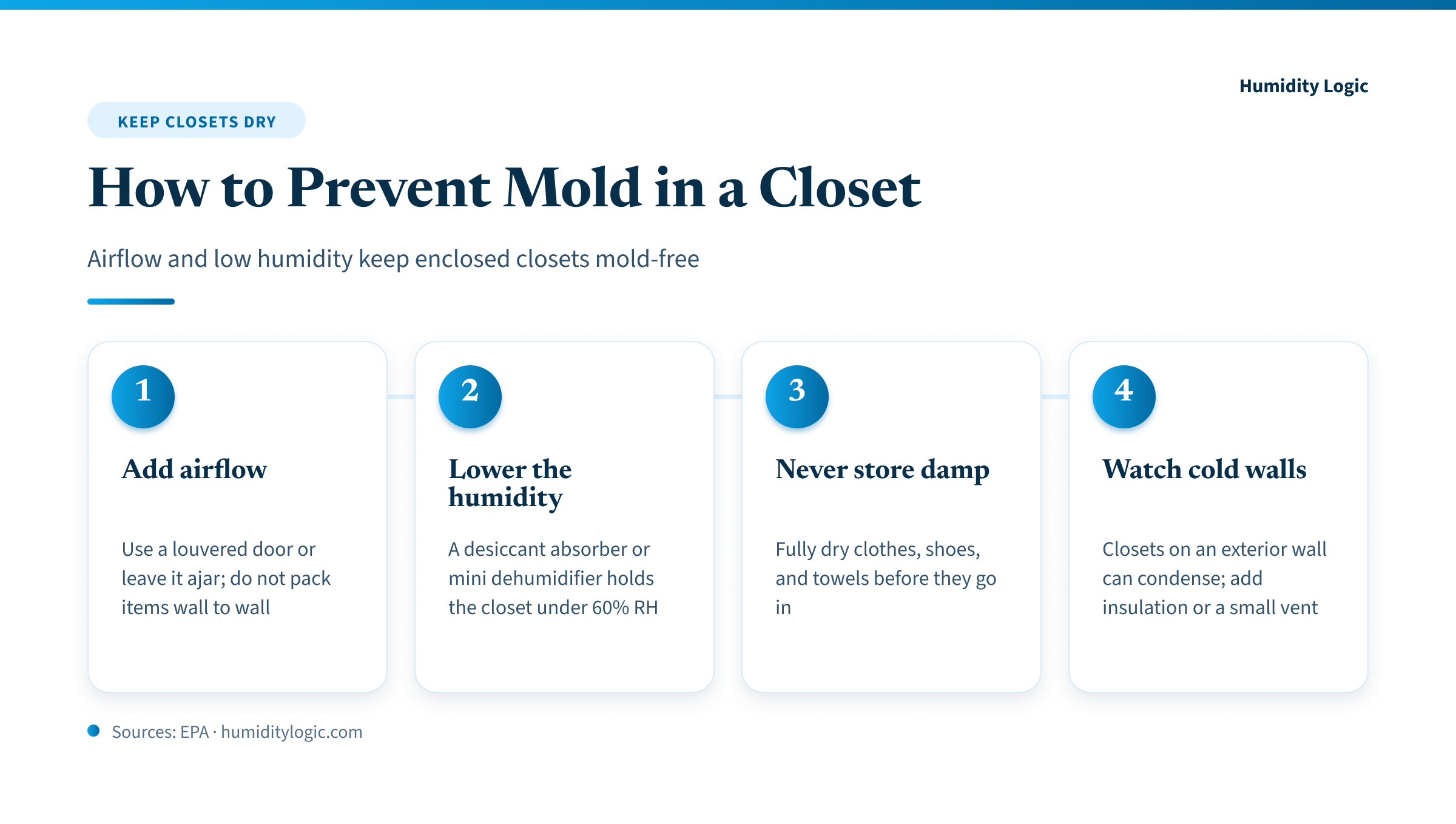
Closets grow mold and musty smells because of three things working together: poor airflow in an enclosed space, a cold exterior wall where humid air condenses, and damp clothing or shoes stored inside. Prevention comes down to two moves — get air moving and keep humidity under 60%. Add a louvered or ajar door, don’t pack items wall to wall, run a small desiccant absorber or mini dehumidifier, and never put anything away damp. Because mold needs moisture to grow, controlling moisture is what controls the mold.
Why do closets grow mold and smell musty?
A closet grows mold because it stacks up the exact conditions mold needs: moisture, a surface to feed on, and no disturbance. According to the US EPA, “Mold can grow on virtually any organic material as long as moisture and oxygen are present,” and clothing, cardboard boxes, wood shelving, and drywall are all organic food sources. Take away the moisture and the still air, and mold has nothing to work with.
Three features of a typical closet make it the dampest, moldiest pocket of a room:
- It’s enclosed with poor airflow. A solid closet door seals the space, so humid air just sits there. Mold thrives in still, damp air, and a closed reach-in barely exchanges air with the rest of the room.
- It often shares a cold exterior wall. A closet built against an outside wall stays cooler than the room, so warm, humid indoor air condenses on that cool surface — the same physics behind condensation on windows. That thin film of moisture is all mold needs.
- It holds damp items. Coats, gym clothes, and shoes carry moisture in with them. In a dark, still closet, that dampness has nowhere to go.
That musty odor isn’t the fabric itself — it’s airborne mold and mildew growing on the moisture. If you want to confirm what you’re smelling, our guide on what mold smells like walks through the earthy, stale signature that tells you moisture has been sitting too long.
Mold can also grow where you can’t see it — the EPA points to “cold corners behind furniture where condensation forms” and the back side of drywall as common hidden spots. In a closet, that means the wall behind a packed clothes rail or the corner a storage bin blocks off can be growing mold long before anything shows on the visible surfaces, which is another reason airflow matters as much as cleaning.
What humidity level prevents mold in a closet?
Keep the closet under 60% relative humidity, and aim for the 30–50% range the EPA recommends for the whole home. The EPA’s home guide is direct: “keep indoor humidity below 60 percent (ideally between 30 and 50 percent) relative humidity.” That’s your target inside the closet, not just the hallway outside it.
The 60% line matters because it’s the point where surfaces stay damp enough for mold to establish. A closet against a cold wall can run well above the rest of the room, so the reading in your bedroom isn’t the reading in the closet. A cheap hygrometer on the shelf tells you the truth, and if you want a quick reference for what your number means, run it through our humidity comfort checker. If you’re regularly seeing readings in the 60s or higher, that’s firmly in high-humidity territory and the closet needs active drying, not just better habits.
How do I keep a closet dry to stop mold?
Prevention is cheap and low-effort: get air moving, hold the humidity down, and stop bringing moisture in. These four habits do almost all the work.
Improve the airflow. This is the single biggest lever in an enclosed space.
- Swap a solid door for a louvered door, or simply leave the door cracked open when you can. The EPA lists increasing “air movement by opening doors and/or windows” as a basic way to cut indoor moisture.
- Don’t overpack. Leave finger-width gaps between garments and a little space around bins so air can actually circulate. Packed-in clothing traps moisture against fabric.
- Keep items an inch or two off exterior walls and up off the floor with open wire shelving, so nothing sits against the coldest, dampest surfaces.
Lower the humidity. Airflow alone may not be enough against a cold wall in a humid month. A small desiccant absorber — a cartridge of silica gel or a tub of moisture-absorbing crystals — quietly pulls water out of still closet air with no power. In a large, chronically damp walk-in with an outlet, a mini dehumidifier does more. Either way, the goal is the same: hold the space under 60%.
Never store anything damp. The EPA notes that wet materials generally need to be dried “within 24-48 hours” to avoid mold, and a closet is the worst place to test that limit. Let coats, workout clothes, and towels dry completely before they go in. Damp laundry is a common culprit — if your towels already smell off, fix that first with our guide on removing mildew smell from towels, because a musty towel will seed the whole closet.
Handle the cold wall. If the back wall of the closet is a cold exterior wall, the EPA’s remedy is to raise the surface temperature: “insulate or increase air circulation.” Adding insulation, or a small passive vent that lets closet air mix with the room, stops the condensation that feeds mold on that surface.
Do I need a dehumidifier, or is airflow enough?
For a small reach-in closet in a reasonably dry house, airflow plus dry storage habits are often enough. The moment you’re fighting a cold exterior wall, a basement location, or a humid climate, you’ll want active drying too.
Think of it as a ladder. Start with the free fixes — open or louvered door, no overpacking, nothing stored damp. If the closet still reads above 60% or the musty smell keeps coming back, add a passive desiccant absorber. If it’s a large walk-in that stays visibly clammy year-round and has an outlet, step up to a small powered unit. A dehumidifier for mold plus better airflow is the durable fix when moisture is persistent; repeated wiping without drying the air just resets the clock.
One habit ties it together: recharge or empty a desiccant unit the moment it saturates. A full cartridge stops absorbing and lets humidity creep right back up, and in humid months a reach-in can swing high fast. If the smell returns within days of cleaning, that’s the signal your moisture control is undersized for the space — not that you need a stronger cleaner.
What if there’s already mold in the closet?
Small patches you can clean yourself, but only after you fix what’s wetting the closet. The EPA’s cleanup guidance sets a clear line: “If the moldy area is less than about 10 square feet (less than roughly a 3 ft. by 3 ft. patch), in most cases, you can handle the job yourself.” Above that, or after major water damage or flooding, the job needs a professional, because disturbing a large colony can spread spores through the home.
Whatever the size, fix the water problem first — the EPA is blunt that mold grows back on anything that stays wet. Scrub mold off hard surfaces like painted shelving with detergent and water and dry completely. Porous items that stay musty after cleaning, such as a moldy fabric liner or cardboard box, are often best thrown out, since the mold can be impossible to remove fully. Then put the prevention steps above in place so the closet stays dry and the smell doesn’t return.
Frequently asked questions
How do I prevent mold in my closet?
Give the closet airflow and keep humidity under 60 percent. Swap a solid door for a louvered one or leave it ajar, don't pack clothes rail-to-rail, add a desiccant absorber or mini dehumidifier, and never store anything damp. Because mold needs moisture to grow, controlling moisture is what controls the mold.
Why does my closet keep growing mold and smelling musty?
Closets combine three mold-friendly conditions: they are enclosed with little airflow, they often share a cold exterior wall where warm indoor air condenses, and they hold damp clothing and shoes. That musty smell is airborne mold and mildew feeding on the trapped moisture, so it returns until the moisture and stale air are fixed.
What humidity level prevents mold in a closet?
Keep the closet under 60 percent relative humidity, and ideally in the 30 to 50 percent range the EPA recommends for the whole home. Above 60 percent, surfaces stay damp enough for mold to take hold, so that ceiling is the number to watch with a small hygrometer or humidity checker.
Does leaving a closet door open prevent mold?
It helps a lot. Opening the door, or replacing a solid door with a louvered one, lets humid air escape instead of sitting still against clothes and walls. The EPA lists increasing air movement by opening doors as a basic way to reduce indoor moisture, though on a cold exterior wall you may also need a dehumidifier or insulation.
How fast does mold grow on damp clothes in a closet?
Quickly. The EPA notes that materials left wet generally need to be dried within 24 to 48 hours to avoid mold growth. A sweaty shirt or wet towel hung in a dark, still closet can start to smell musty within a couple of days, which is why fully drying items before they go in matters so much.
Sources & references
Every figure on this page is checked against these published sources. Last reviewed August 1, 2026.