Waterproofing and a dehumidifier solve two different halves of the same problem, so the honest answer is usually both — but in a specific order. Waterproofing fixes the source: it stops bulk water and liquid seepage from entering through the foundation. A dehumidifier manages the symptom: it removes water vapor that is already in the air. If water is actively getting into your basement, fix that first — no dehumidifier can outpace an active leak. Once the space is dry, a right-sized dehumidifier handles the residual humidity that always lingers below grade. They work together; they are not an either/or choice.
The mistake that costs people money is buying a dehumidifier and expecting it to solve a water-entry problem it was never built to touch. This guide sorts out which problem you actually have, so you spend on the right fix.
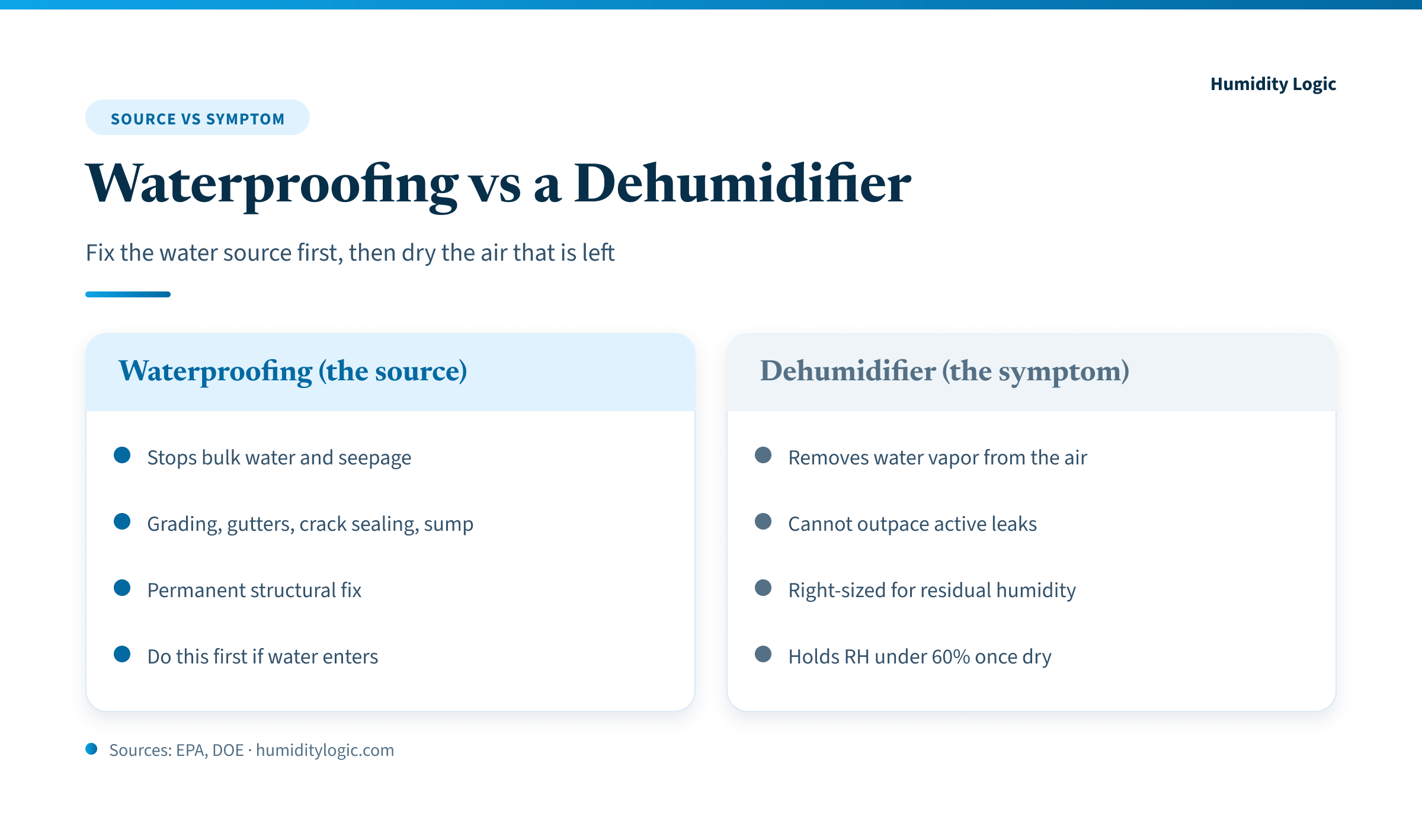
Source vs symptom: what each one actually does
Think of a wet basement as having two layers of moisture. The first is bulk water — liquid water pushing in through cracks, the joint where the wall meets the floor, or a failing exterior seal after every rain. The second is water vapor — humidity in the air, which rises when bulk water evaporates, when warm summer air meets cool below-grade walls, and when moisture wicks through bare concrete.
Waterproofing attacks the first layer. Grading soil away from the house, extending downspouts, sealing cracks, and installing an interior perimeter drain with a sump pump all stop liquid water at or before the wall. A dehumidifier attacks only the second layer — it pulls vapor out of the air and drips it into a drain, then holds the room at your humidity target.
The EPA is direct about the sequence: “The key to mold control is moisture control,” and that means you “fix the water problem” at its source, not just treat the air. A dehumidifier does not stop seepage, relieve hydrostatic pressure, or fix grading. If bulk water keeps arriving, the dehumidifier is emptying a bathtub with the faucet still running — which is exactly why so many end up running constantly and never win.
How do I tell which problem I have?
Before you spend a dollar, diagnose. Look for the signs of bulk water:
- Puddles or damp patches on the floor, especially after rain or snowmelt
- Wet streaks or trickles running down the foundation wall
- Water at the seam where the wall meets the floor
- A sump pump that cycles hard during storms
- Efflorescence — white mineral crust — or peeling paint on the walls
Any of those means liquid water is entering, and that is a waterproofing job. Now the signs of a pure vapor problem, where the surfaces stay dry but the air is heavy:
- A hygrometer that reads above 60 percent with no visible wet spots
- A persistent musty smell but a dry floor
- Condensation on cold walls, pipes, or windows
- Clammy air that never quite dries out in summer
If you only see the second list, a dehumidifier alone may be enough. If you see anything from the first list, waterproofing comes first — full stop. Our wet basement guide walks through tracing the water to its entry point, and the basement humidity guide covers the vapor side in more depth.
Waterproofing vs a dehumidifier: side by side
| Factor | Waterproofing | Dehumidifier |
|---|---|---|
| Problem it solves | Bulk water and liquid seepage (the source) | Water vapor in the air (the symptom) |
| How it works | Diverts, blocks, or drains liquid water | Condenses moisture out of the air |
| Handles an active leak | Yes — that is its whole job | No — it cannot keep up |
| Permanence | Structural, long-lasting fix | Ongoing appliance, runs as needed |
| Typical cost | A few hundred to $15,000+ | Roughly $200 to $400 |
| Holds RH under 60% | Not by itself | Yes, once the space is dry |
| Do it | First, if water is entering | After the water is stopped |
What order should I fix things in?
Building scientists and the EPA both frame this as working from the source outward, cheapest fixes first.
1. Fix the free stuff outside. Most wet basements are fed by rainwater that never should have reached the foundation. Regrade so the soil slopes away from the house — the EPA guidance is to keep the ground sloping down and away so water does not collect against the wall. Clean the gutters and extend downspouts so they discharge water 4 to 6 feet out. These steps cost little to nothing and solve a surprising share of basement water problems on their own.
2. Seal and drain the interior. If water still enters, move to crack sealing (crack injection typically runs $800 to $1,500 per crack) or, for chronic seepage, an interior perimeter drain feeding a sump pump. That drainage system runs about $60 to $120 per linear foot, with the sump pump itself roughly $1,200 to $2,500 installed, according to This Old House.
3. Excavate only if you must. Full exterior waterproofing — digging around the foundation and applying a membrane — is the most thorough and the most expensive route, commonly $7,000 to $15,000 and higher on large or deep foundations. It is reserved for serious, persistent water intrusion the interior methods cannot control.
4. Then dehumidify the rest. Once the space stays dry, there is still residual humidity below grade, and that is the dehumidifier’s job. Size it to the room with the dehumidifier size calculator rather than guessing, and see the basement dehumidifier guide for placement and drainage.
Why can’t a dehumidifier just handle it all?
Because a dehumidifier only ever touches air. US DOE Building America research on humidity control treats moisture management as a layered system — control the liquid-water loads first, then size mechanical dehumidification for the vapor that remains. If you skip the first layer, the machine faces a moisture load that never ends.
Picture a basement taking on a gallon of seepage after every storm. The dehumidifier senses the spike, kicks on, and tries to pull that water back out of the air as fast as it evaporates. It runs nonstop, drives up your electric bill, wears out early, and the readout still won’t drop below 60 percent — because the source is still open. Stop the water, and that same dehumidifier suddenly has a small, steady job it can actually win.
There is also a health and structure angle. A dehumidifier suppresses the conditions for mold, but it does not remove standing water, relieve the pressure cracking your foundation, or dry materials that are being re-wetted daily. Those are exactly the problems waterproofing exists to solve.
The bottom line
Waterproofing and a dehumidifier are partners, not rivals. Waterproofing stops the source — the bulk water and seepage coming through your foundation — and it is where your money goes first if water is entering. A dehumidifier manages the symptom — the humid air that remains once the space is dry — and it is what holds your basement in the EPA’s target range of under 60 percent, ideally 30 to 50 percent, over the long run. Diagnose which problem you have by looking for liquid water versus merely damp air, fix the water before you fight the humidity, and you will stop wasting a dehumidifier on a job it was never built to do. If you are chasing whole-house dampness beyond the basement, our guide on how to lower humidity in your house covers the rest of the home.
Frequently asked questions
Do I need waterproofing or just a dehumidifier for my basement?
It depends on whether liquid water is getting in. If you see puddles, wet streaks after rain, seepage at the wall-floor joint, or a sump that runs hard, that is bulk water and waterproofing is the real fix. If the floor and walls stay dry but the air feels damp and a hygrometer reads over 60 percent, that is a vapor problem and a right-sized dehumidifier is the answer. Many basements need both: waterproofing to stop the water, then a dehumidifier for the humidity that remains.
Can a dehumidifier fix a leaking or wet basement?
No. A dehumidifier only removes water vapor from the air. It does not stop water seeping through a foundation wall, relieve hydrostatic pressure, or fix bad grading and gutters. If liquid water is actively entering, a dehumidifier will run constantly and still lose, because it is trying to dry a source it cannot reach. The EPA is clear that the key to controlling moisture is fixing the water problem at its source first.
How much does basement waterproofing cost compared to a dehumidifier?
A quality basement dehumidifier runs roughly $200 to $400. Waterproofing costs far more because it is a structural repair: simple exterior fixes like regrading and downspout extensions can be a few hundred dollars, interior perimeter drain and sump systems run about $60 to $120 per linear foot, and full exterior excavation and membrane work can reach $7,000 to $15,000 or more. The higher cost reflects that waterproofing solves the source, not just the symptom.
What order should I fix basement moisture problems in?
Work from the outside in. First fix free, cheap drainage: regrade so soil slopes away from the foundation and extend downspouts 4 to 6 feet out. Next address interior water entry with crack sealing or, if needed, an interior drain and sump. Only after the space stays dry should you size and run a dehumidifier for the leftover humidity. Drying the air before stopping the water just masks the problem.
What humidity level should a basement stay at after waterproofing?
Keep relative humidity below 60 percent at all times, and ideally between 30 and 50 percent. The EPA points to that range because mold, dust mites, and musty odors take hold once the air stays above roughly 60 percent. Once waterproofing has stopped the bulk water, a properly sized dehumidifier is what holds the basement in that safe range through humid summers and damp shoulder seasons.
Sources & references
Every figure on this page is checked against these published sources. Last reviewed July 27, 2026.